

A clear, repeatable and verifiable BIM process
In complex projects, “BIM” primarily means information control: who produces what, when, in what format, and how it is checked. Our method combines clear requirements (EIR/LOIN), CDE-based collaboration and continuous verification, so delivery remains predictable.
We start by translating the client’s objectives into clear BIM requirements, delivery rules and responsibilities. This allows every party to understand what information is needed, why it is needed and how it must be delivered. From the beginning, we set up the framework for collaboration, review and approval, so the BIM process supports the project instead of becoming an additional layer of complexity.
During the project, we monitor the quality and consistency of information through structured coordination, model checking and regular reporting. We do not treat BIM as a one-time deliverable, but as a controlled process that evolves with the project. This helps teams identify issues earlier, reduce uncertainty and deliver information that is reliable, traceable and useful for design, construction and operation.
Work stages
01
Requirements and documentation review
We review the brief, contract, client requirements, involved disciplines, and the current BIM maturity level. We define the project objectives and success criteria.
02
BIM strategy definition
We prepare/validate the EIR, BEP, MIDP/TIDP, roles and the RACI matrix. We define the LOIN, naming conventions, modelling rules and acceptance criteria.
03
Technical setup (CDE and project standards)
We configure the CDE (folder structure, naming, access rights, approval workflows), the model structure and the delivery packages. We set communication channels and the meeting cadence.
04
3D Modeling and coordination
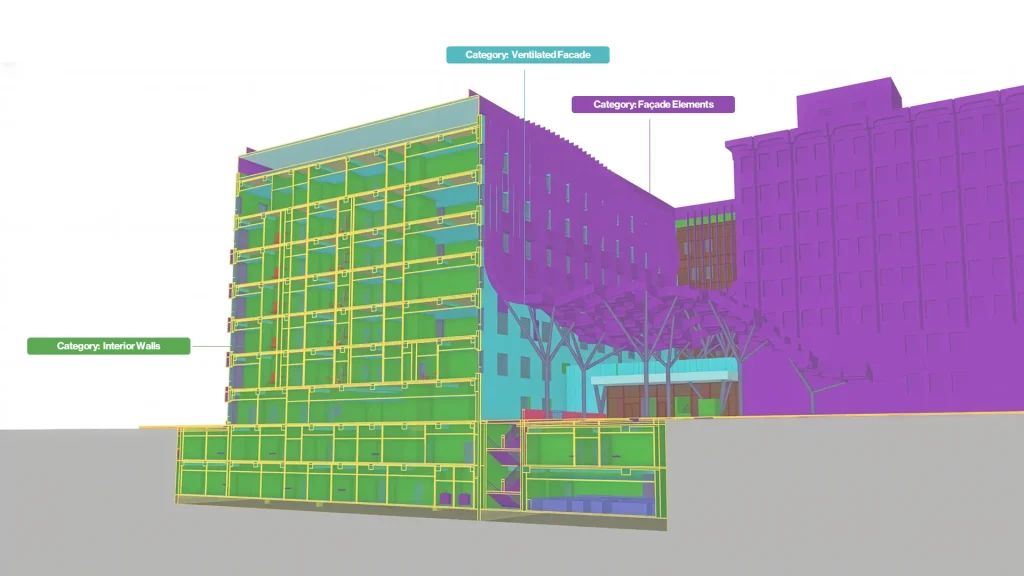
Interdisciplinary modelling and coordination, clash detection, issue management, reporting and regular meetings. We track conflicts through to closure and maintain full traceability.
05
Deliverables and construction-phase support
We publish deliverables by project stage, manage changes (RFIs / site instructions), provide technical support and controlled model updates.
06
Project close-out and lessons learned
Final handover (models, reports, document sets), as-built if applicable, post-review and recommendations for improvement.
Standardization & quality
We apply QA/QC checks (manual and automated) and maintain revision traceability. We align with ISO 19650 principles for information management: clear responsibilities, approval workflows, delivery records and change control.
Collaboration with our clients
We work with our clients as a strategic BIM partner, not only as a technical service provider. Our role is to understand the project objectives, define the right information management framework and support the team throughout the entire delivery process. We help clients transform BIM requirements into clear workflows, responsibilities and measurable deliverables, so collaboration becomes structured, transparent and easier to control.
At the beginning of each project, we align expectations with the client and the project team. We define what information is needed, when it must be delivered, who is responsible for it and how it will be checked. This creates a clear basis for collaboration and reduces ambiguity from the start.
During the project, we stay involved through coordination, verification and regular communication. We monitor the quality of information, support decision-making and help the team resolve issues before they become critical. Our process is built around clarity, traceability and predictable delivery.
FAQ
What is BIM
BIM, or Building Information Modeling, is a structured way of creating, managing and using project information throughout the life of a building or infrastructure asset.
It is not just a 3D model. BIM brings together geometry, technical data, documentation, responsibilities and workflows in a coordinated digital process. This allows clients, designers, contractors and operators to work with more reliable information, make better decisions and reduce errors throughout design, construction and operation.
What are BIM use cases?
BIM use cases describe the specific ways in which BIM will be used on a project.
For example, BIM can be used for 3D coordination, clash detection, quantity take-off, design review, construction planning, site verification, asset data management or digital handover.
Defining BIM use cases from the beginning helps all parties understand what the models are being developed for, what information they need to contain, who is responsible for producing it and how it will support project decisions.
How can BIM actually help reduce my project’s costs?
BIM is not an additional project cost. It is a cost-control strategy.
While BIM requires an upfront investment in planning, coordination and information management, its value is measured by the costs it helps avoid. By improving multidisciplinary coordination, identifying clashes before construction, increasing quantity accuracy and reducing rework, BIM helps prevent many of the budget overruns that traditionally occur during design and construction.
The result is greater cost certainty, fewer surprises on site and better protection of the project’s financial objectives.
What are the benefits of implementing BIM?
The main benefit of BIM is better control over project information. This in turn translates in reducing costs associated to insufficient information, miscommunication and rework.
A well-implemented BIM process helps teams work with coordinated and up-to-date information, identify problems earlier, reduce design and construction errors, improve communication between stakeholders and support more informed decisions.
For clients, BIM offers greater transparency and better control over deliverables. For designers, it supports coordination and consistency. For contractors, it helps reduce uncertainty during construction. For operators, it can provide structured information for maintenance and asset management after handover.